What Happens After You Invest in a Multifamily Syndication?
You've reviewed the opportunity, decided it aligns with your investment goals, signed the investment documents, and wired your funds.
Now what?
Once your investment is complete, your role shifts from evaluating the opportunity to becoming a Limited Partner (LP), a passive owner in the property. From that point forward, the General Partner (GP) or operating team takes responsibility for managing the asset, executing the business plan you've reviewed, and keeping you informed throughout the investment.
Although LPs aren't involved in the property's day-to-day operations, a tremendous amount of work takes place behind the scenes over the next several years by the operating team.
Understanding that process can help set realistic expectations and provide a clearer picture of how multifamily syndications create value over time.
Here's a simplified look at what typically happens after you become an LP in a multifamily syndication.
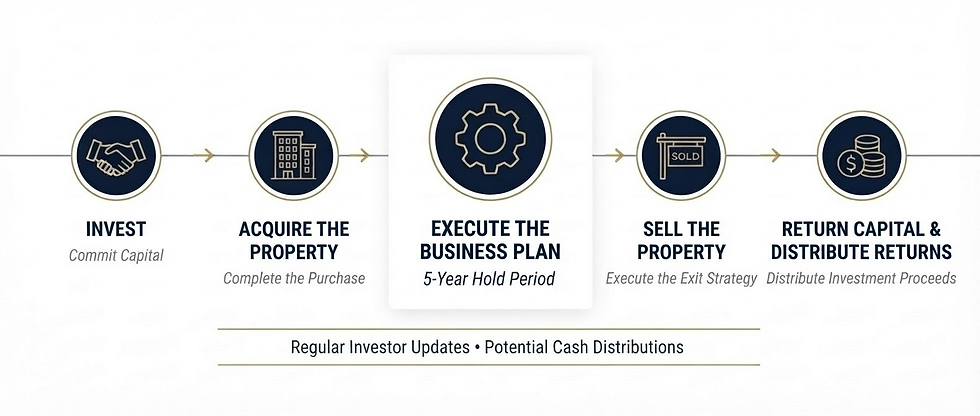
Now let's take a closer look at each stage of the investment lifecycle.
Closing the Acquisition
Once the investment has been fully funded by you and the other investors, the operating team begins the final steps toward completing the acquisition.
Although financing has typically been approved before investors commit their capital, several important closing activities must still be completed before ownership officially transfers. During this period, the operating team works closely with attorneys, title companies, insurance providers, lenders, the seller, and numerous other professionals to satisfy the remaining closing requirements..
This process often includes:
Finalizing loan documentation with the lender
Completing legal closing documents
Confirming insurance coverage
Coordinating title and ownership transfers
Establishing bank accounts and accounting systems
Transitioning vendor contracts and utility accounts
Finalizing the property management agreement and operational transition
Preparing financial reporting systems and investor records
Just as importantly, preparations are made for the residents who already call the community home.
Every operator handles this differently, but at Jewels & Crown, we believe communication with residents is an important part of a successful transition. We make sure residents understand who we are, what they can expect during the ownership transition, and where to go with any questions. Creating a positive experience from the beginning helps build trust, and happy residents are more likely to renew their leases, recommend the community to friends and family, and contribute to a stronger investment over the long term.
Once closing is complete, the focus shifts to executing the business plan.
Executing the Business Plan
Before investing, LPs have the opportunity to review the property's business plan and decide whether the investment and the operating team's strategy align with their investment goals.
After closing, that strategy moves from a plan on paper to day-to-day execution. This is where the majority of the operating team's time and attention is spent throughout the life of the investment.
Executing a multifamily business plan requires coordinating many moving pieces at the same time. While property management oversees the day-to-day operations of the community, the operating team provides strategic leadership, sets priorities, and works closely with property management to execute the investment strategy.
The operating team's responsibilities typically include:

Each area shown above represents an important part of executing the business plan. While every investment is different, let's take a closer look at what the operating team is typically focused on throughout the hold period.
Building the Property Management Partnership
One of the operating team's first priorities before closing is establishing a strong partnership with the property management company.
In some cases, the existing management company remains in place. In others, a new property management company is brought on to better align with the investment strategy.
Regardless of the situation, the operating team works closely with property management to communicate the business plan, establish expectations, define performance goals, and ensure everyone is aligned from the beginning.
Property management serves as the operating team's boots on the ground. They interact with residents every day, oversee leasing, coordinate maintenance, supervise vendors, and execute many aspects of the business plan. Because of this, a strong partnership between the operating team and property management is one of the most important drivers of a successful investment.
Renovating Apartment Units
Renovating apartment units often involves much more than selecting new finishes. The operating team determines which units should be renovated first, develops renovation schedules, coordinates contractors, monitors budgets, oversees timelines, and works closely with property management to minimize disruption for both current and prospective residents.
Improving the Community
This may involve improving amenities such as clubhouses, fitness centers, playgrounds, dog parks, outdoor gathering spaces, package lockers, or laundry facilities. It can also include enhancing curb appeal through landscaping, exterior paint, updated signage, parking lot improvements, lighting, and other safety improvements that make the community more welcoming while protecting the long-term value of the property.
Rebranding the Community
If appropriate, the operating team may update the property's name, signage, branding, or overall identity to better reflect the improvements being made and reposition the community within its market.
Optimizing Property Operations
Executing a successful business plan requires more than physical improvements.
The operating team continually evaluates how the property is being operated. This may involve onboarding a new property management company, implementing reporting systems, refining leasing strategies, establishing operating procedures, strengthening financial controls, and creating processes that improve efficiency and accountability.
Throughout the investment, the operating team provides strategic direction while property management executes the day-to-day operations. Regular communication ensures everyone remains aligned with the business plan and investment objectives.
Managing Expenses Responsibly
Every operating expense is evaluated to determine whether it continues to provide value.
This may include reviewing vendor contracts, negotiating better pricing, replacing underperforming service providers, identifying operational efficiencies, and making changes where necessary. The goal isn't simply to spend less, but to maximize value while maintaining the quality of the property and the resident experience.
Increasing Occupancy
Vacant apartment units generate no rental income.
The operating team works closely with property management to strengthen marketing efforts, improve leasing strategies, and attract qualified residents in order to increase occupancy and support the property's financial performance.
Improving Resident Retention
Keeping great residents is often more valuable than finding new ones.
The operating team and property management continually look for ways to improve communication, respond quickly to maintenance requests, enhance the resident experience, and create a community that people are proud to call home. Happy residents are more likely to renew their leases, take better care of their homes, and recommend the community to friends and family, benefiting both residents and investors over the long term.
Throughout this process, the operating team continually evaluates market conditions and property performance. While the business plan serves as the roadmap, successful execution requires flexibility. Construction timelines change, economic conditions evolve, resident needs shift, and unexpected challenges inevitably arise. One of the operating team's most important responsibilities is adapting thoughtfully while remaining focused on the long-term investment objectives shared with investors.
Leading the Investment
Executing a business plan isn't something that happens once a month when financial statements arrive.
Throughout the investment, the operating team remains actively engaged with property management, often through weekly operating calls, regular reporting, and site visits.
These meetings typically include discussions around:
Occupancy and leasing performance
Rent collections and delinquency
Renovation progress
Maintenance and capital projects
Resident feedback
Staffing
Financial performance
Budget variances
Key performance indicators (KPIs)
Upcoming priorities and challenges
This ongoing collaboration allows the operating team to identify issues early, make informed decisions, and keep the investment moving in the right direction.
Many of the updates shared with Limited Partners are informed by these ongoing conversations, giving investors transparency into both the property's performance and the progress being made toward the business plan.
Providing Investor Updates
Although LPs are not involved in managing the property, they should expect regular communication from the operating team.
Most sponsors provide periodic investor updates that may include:
Occupancy and leasing performance
Renovation progress
Financial performance
Market conditions
Major accomplishments
Challenges encountered
Outlook for the coming months
While communication schedules vary, quarterly updates are common, with additional communication provided for significant events.
Regular updates help investors understand not only what is happening at the property, but why certain decisions are being made throughout the investment.
Making Cash Distributions
Many multifamily syndications are designed to generate cash flow for investors through periodic distributions.
When the property's operating performance supports it, a portion of available cash may be distributed to Limited Partners according to the terms outlined in the offering documents.
Distribution schedules vary by investment, but quarterly distributions are common.
It's important to remember that distributions are based on the property's actual performance. If unexpected expenses arise or market conditions change, distributions may be reduced, delayed, or temporarily suspended in order to protect the long-term health of the investment and maintain appropriate operating reserves.
On the other hand, if the property performs better than projected and that performance appears sustainable, distributions may increase over time. Decisions to adjust distributions are made carefully, balancing current investor returns with the long-term success of the investment.
The Investment Evolves Over Time
Unlike publicly traded stocks, multifamily investments are typically designed to be held for several years.
As renovations are completed, occupancy improves, operations become more efficient, and net operating income increases, the property's value may also grow.
Throughout the hold period, the operating team continually evaluates market conditions, financing opportunities, and overall investment performance. Depending on market conditions and the business plan, this may include refinancing the property, continuing to operate it, or preparing it for sale when the timing is favorable.
Selling the Property
Eventually, the investment reaches its planned exit.
Every investment is different, and market conditions play an important role in determining the timing of a sale. At Jewels & Crown, however, we generally underwrite investments with an anticipated holding period of approximately five years. We believe this often provides sufficient time to execute the business plan, create meaningful value through strategic improvements, and position the property to support our projected investor returns.
When the property is sold:
The outstanding loan is paid off.
Selling expenses are deducted.
Remaining proceeds are distributed to LPs and GPs according to the partnership agreement.
For many investors, the sale represents the largest portion of their overall return, reflecting the value created throughout the investment's holding period.
A Truly Passive Investment Experience
One of the primary reasons investors choose multifamily syndications is that they can participate in professionally managed commercial real estate without taking on the responsibilities of ownership.
Instead of managing maintenance requests, leasing apartments, or overseeing contractors, LPs can remain focused on their careers, businesses, families, and other priorities while experienced professionals execute the investment strategy.
Passive investing doesn't mean being disconnected. A quality operating team provides transparent communication, disciplined execution, and thoughtful stewardship throughout the life of the investment.
Final Thoughts
Investing in a multifamily syndication isn't the end of the process. It's the beginning of a long-term partnership.
As an LP, your role is to invest thoughtfully and select an operating team you trust. From there, the GP team goes to work managing the asset, executing the business plan, navigating challenges, communicating progress, and stewarding your capital on your behalf.
When executed well, multifamily syndications allow investors to participate in professionally managed real estate while remaining truly passive, creating the opportunity to build long-term wealth without becoming a landlord.
Ready to Learn More?
If you’ve been thinking about investing in real estate but aren’t sure where to start, or want to explore how multifamily investing can fit into your long-term financial goals:
Let’s help you turn today’s market opportunity into tomorrow’s financial freedom.
This article is for educational purposes only and should not be considered legal, tax, financial, or investment advice. Real estate investing involves risk, including the potential loss of principal. Investors should consult their own tax, legal, and accounting professionals regarding their specific situation before investing.
© Jewels & Crown Ventures. All Rights Reserved.