
How Experienced Operators Increase the Value of an Apartment Community
When people hear “value-add” real estate investing, they often picture renovated apartments: new flooring, updated kitchens, fresh paint, and modern fixtures.
Those improvements can certainly be part of the strategy. But increasing the value of an apartment community involves much more than renovating units or raising rents.
Experienced multifamily operators look at the entire property and how it performs as a business. They evaluate opportunities to improve the apartments and community, strengthen occupancy, increase revenue, manage expenses more effectively, and improve day-to-day operations.
All of those efforts can contribute to one important objective: increasing the property's Net Operating Income (NOI) and, ultimately, its value.
We've previously explained how value-add multifamily investing works and why it can be so powerful. Rather than cover all of that ground again, let's look more closely at what operators can actually do to create that value, and what investors should look for when evaluating an investment opportunity.
A Quick Refresher on How
Multifamily Properties Are Valued
Unlike a single-family home, whose value is largely influenced by comparable home sales, commercial multifamily properties are valued substantially based on the income they produce.
Two terms are important to understand:
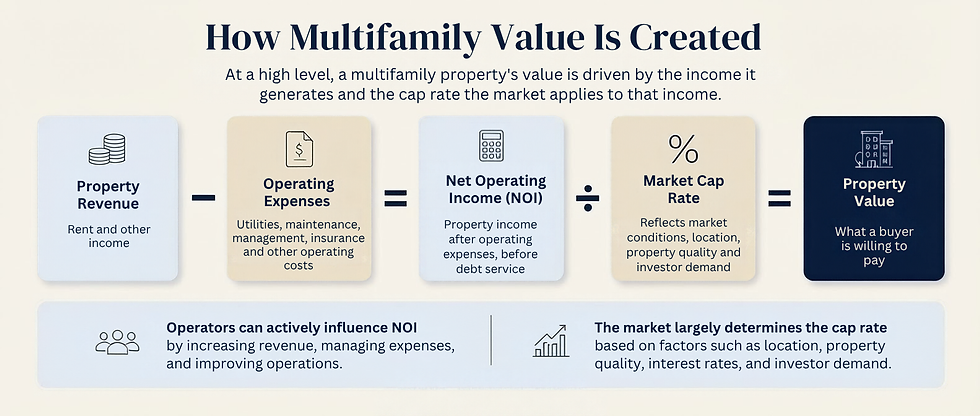
Net Operating Income (NOI) is, in simple terms, the income a property generates after its operating expenses are paid, but before debt service and certain other costs.
Put simply, there are two primary ways an operator can increase NOI: increase the revenue the property generates or manage its operating expenses more effectively.
Capitalization rate, or cap rate, reflects the relationship between a property's NOI and its market value. Cap rates are influenced by broader market conditions, including interest rates and investor demand, as well as characteristics of the individual property, such as its location, condition, quality, and perceived risk. As a result, two apartment communities in the same market may trade at different cap rates.
At a high level, a multifamily property's value is driven by its NOI and the cap rate the market applies to that income.
Operators have the greatest ability to directly influence NOI, but their work can also affect how the property itself is perceived by future buyers. Improving the condition, quality, operations, and overall appeal of a community may make it a more attractive investment when it is eventually sold.
Broader market conditions and the cap rate a future buyer will ultimately be willing to pay, however, remain outside the operator's control.
By increasing revenue, managing expenses effectively, and improving the property itself, an operator can actively work to create value rather than relying exclusively on the overall real estate market to appreciate.
Value Creation Starts With the Business Plan
Ideally, the strategy for creating value doesn't begin after an apartment community is purchased.
It begins before the investment is ever made.
When evaluating a potential acquisition, an experienced operating team should identify the specific opportunities that exist at that property and develop a business plan around them.
Perhaps comparable communities demonstrate demand for renovated apartments that the property doesn't currently offer. Maybe the community lacks amenities residents value, has inefficient utility expenses, suffers from high vacancy or slow unit turns, or has operational opportunities that could improve its financial performance.
Different properties require different strategies.
That is also why investors should pay close attention to the business plan when evaluating a multifamily investment opportunity. The projected returns are important, but so is understanding how the operator expects to achieve them.
A credible value-creation plan should identify specific opportunities at the property and explain how the proposed improvements and operational strategy are expected to strengthen its performance.
1. Improve the Apartments and the Community
Physical improvements are often an important part of a value-add business plan, but they extend well beyond the interiors of individual apartments.
Inside the units, improvements might include updated flooring, appliances, countertops, fixtures, lighting, paint, or other renovations that make apartments more attractive and functional.
The operator may also identify opportunities throughout the community.
That could include improving exterior lighting, adding security cameras or access controls, repairing or resurfacing parking areas, improving landscaping and curb appeal, updating common areas, or addressing deferred maintenance.
There may also be opportunities to add or improve amenities residents value, such as a dog park, playground, outdoor grilling or gathering area, fitness center, package area, covered parking, or other community features appropriate for that particular resident base and market.
The important question isn't simply, “What can we renovate?”
It's “Which improvements will make this a better and more competitive place to live, and do those improvements make financial sense?”
Some improvements may support higher rents. Others may improve resident retention, leasing performance, safety, or the overall desirability of the community. Still others may protect the physical asset or reduce future maintenance costs.
Experienced operators evaluate those potential benefits against the cost of the improvement and the needs of the specific property.
The goal isn't to spend money everywhere. It's to invest capital where it has the potential to create meaningful value.
2. Improve Occupancy and Leasing Performance
A property can have attractive apartments and still underperform if too many units are vacant or leasing operations are inefficient.
That is why experienced operators pay close attention to occupancy, leasing traffic, renewal rates, resident turnover, and how quickly vacant apartments are prepared and returned to market.
Sometimes improving revenue has nothing to do with raising rents.
It may come from improving marketing, responding to leasing inquiries more quickly, making the application process easier, reducing unnecessary downtime between residents, or improving the resident experience so more people choose to renew.
For example, if units are sitting vacant for several weeks because preparing them to be occupied is taking too long, improving that process can get those apartments back online sooner and reduce lost rental income.
The same principle applies to resident retention. Every move-out can create costs associated with vacancy, cleaning, repairs, marketing, and leasing. If residents are happy with the community and choose to stay longer, that can improve both revenue and operating efficiency.
The objective is not simply to fill apartments at any cost. It is to create a community that remains competitive in its market while operating as efficiently as possible.
3. Identify Additional Sources of Revenue
Monthly rent is typically the largest source of income at an apartment community, but it may not be the only one.
Depending on the property, operators may identify opportunities to generate additional revenue from services, amenities, or conveniences residents value.
Examples might include covered or reserved parking, storage units, laundry services, pet-related programs, utility reimbursements, package services, or other community-specific amenities.
The objective should not be to simply add fees wherever possible.
Additional revenue is most sustainable when it is tied to something residents value or when it reflects a cost the property is already incurring on their behalf.
Across dozens or hundreds of apartments, relatively modest improvements in ancillary income can add up and contribute meaningfully to NOI.
4. Manage Operating Expenses Strategically
The revenue side of the business often gets the most attention, but expenses can have an equally important impact on property performance.
Operators regularly review costs such as utilities, maintenance, landscaping, vendor contracts, payroll, insurance, property management, and other recurring operating expenses.
Sometimes there are opportunities to reduce unnecessary costs.
That might mean renegotiating vendor contracts, improving preventive maintenance, reducing water or energy consumption, changing service providers, or identifying expenses that are higher than comparable properties.
But good expense management is not the same thing as cutting costs indiscriminately.
Reducing maintenance staffing, deferring necessary repairs, or eliminating services residents value may save money in the short term while hurting occupancy, resident satisfaction, or the physical condition of the property.
In some cases, spending more can actually support stronger long-term performance.
The objective is to make sure each dollar is being spent thoughtfully and that the property is operating as efficiently as possible without sacrificing the quality of the community.
5. Improve Day-to-Day Operations
This is one of the least visible parts of multifamily investing, but it can also be one of the most important.
An apartment community is not simply a piece of real estate. It is an operating business.
Leasing, maintenance, collections, resident communication, budgeting, accounting, vendor management, renewals, and property management all affect how that business performs.
Experienced operators continually monitor those areas and compare actual performance to the business plan.
Are vacant apartments being prepared quickly enough? Are leasing leads being followed up on? Are residents paying on time? Are maintenance requests being handled efficiently? Are renewals tracking as expected? Are expenses in line with budget? Are the improvements being made at the property producing the results that were anticipated?
Good operations rarely come down to one dramatic decision.
More often, value is created through dozens of smaller decisions made consistently over time.
How Small Improvements Can
Create Significant Value
This is where the connection between operations and property value becomes especially important.
Because multifamily properties are valued substantially based on income, an improvement in NOI can have a significant effect on value.
Consider a simple hypothetical example.
If an operator is able to increase annual NOI by $100,000 and a 5.5% cap rate is applied to that additional income, it could represent approximately $1.82 million in additional property value.
That doesn't mean every $100,000 increase in NOI will always produce exactly that result. Cap rates can change, and market conditions ultimately influence what a buyer is willing to pay.
But the example illustrates why operators focus so closely on occupancy, leasing, expenses, ancillary income, renovations, and operational efficiency.
The impact is rarely the result of one single initiative.
It may be a combination of slightly higher occupancy, faster unit turns, more resident renewals, improved utility management, additional parking revenue, renovated apartments, and more efficient operations.
Each improvement may appear relatively small on its own.
Together, they can materially improve the financial performance and value of the property.
What Investors Should Look for in a
Multifamily Business Plan
When evaluating an investment opportunity, it is easy to focus primarily on projected returns.
Those projections matter, but investors should also understand the assumptions behind them.
A business plan should explain more than the operator's intention to “increase rents,” “reduce expenses,” or “sell the property for more in five years.”
Investors should be able to understand how the operator expects to create that value.
Some questions to consider include:
What physical improvements are planned, and how much capital has been budgeted for them?
Are comparable properties supporting the projected rental increases?
Are the assumptions for occupancy and rent growth reasonable for the market?
What operational opportunities has the team identified?
Are there specific opportunities to increase other sources of property revenue?
Which expenses are expected to change, and why?
How dependent are projected returns on future market appreciation versus improvements the operator can actively influence?
What assumptions are being made about the property's eventual sale?
The strongest business plans are generally grounded in specific, identifiable opportunities rather than relying primarily on optimistic future market conditions.
Of course, that does not mean every projected improvement will occur exactly as planned. Markets change. Expenses change. Resident preferences change. Unexpected issues can arise.
But investors should be able to see a clear connection between the strategy being proposed and the returns being projected.
Projected returns matter. But investors should also understand how the operator expects to create them.
How We Think About Value Creation
at Jewels & Crown
At Jewels & Crown, actively creating value is a core part of our investment strategy.
Before acquiring a property, we develop a detailed business plan based on the specific opportunities we identify at that community.
That may include apartment renovations, community improvements, operational efficiencies, revenue opportunities, expense management, or a combination of strategies.
We also evaluate whether the projected improvements are supported by the surrounding market and whether the costs required to execute them make financial sense.
The goal is not to force a predetermined renovation plan onto every property. It is to identify the areas where we believe thoughtful improvements can strengthen the community, improve its financial performance, and increase its long-term value.
Once we acquire a property, the work continues throughout the investment period. We monitor performance against the business plan, evaluate what is working, and adjust where appropriate as the property and market evolve.
And because we invest our own capital alongside our investors, we are working toward the same outcome: protecting the investment while creating opportunities to grow its value over time.
Final Thoughts: The Operator Matters
Buying the right apartment community is only part of the investment. What happens after acquisition matters just as much.
The operating team must execute the business plan, manage the property through changing conditions, decide where to invest capital, respond when assumptions change, and continually look for opportunities to strengthen performance.
For passive investors, much of that work happens behind the scenes.
But that active management is a major part of what can turn an apartment community from the property that was originally purchased into a stronger, more valuable asset at the time of sale.
And that is ultimately one of the biggest distinctions in value-add multifamily investing:
The operator is not simply waiting for the market to create value. The operator is actively working to create it.
Ready to Learn More?
If you’ve been thinking about investing in real estate but aren’t sure where to start, or want to explore how multifamily investing can fit into your long-term financial goals:
This article is for educational purposes only and should not be considered legal, tax, financial, or investment advice. Real estate investing involves risk, including the potential loss of principal. Investors should consult their own tax, legal, and accounting professionals regarding their specific situation before investing. There is no guarantee that any investment strategy will be successful or that targeted returns will be achieved.
© Jewels & Crown Ventures. All Rights Reserved.


